Showing posts with label gender studies. Show all posts

Friday, March 19, 2021

Q&A with Dr. Anna Peppard on Sexuality, Fantasy, and the Superhero

From Superman, created in 1938, to the transmedia DC and Marvel universes of today, superheroes have always been sexy. And their sexiness has always been controversial, inspiring censorship and moral panic. Yet though it has inspired jokes and innuendos, accusations of moral depravity, and sporadic academic discourse, the topic of superhero sexuality is like superhero sexuality itself—seemingly obvious yet conspicuously absent. Supersex: Sexuality, Fantasy, and the Superhero is the first scholarly book specifically devoted to unpacking the superhero genre’s complicated relationship with sexuality.

More info
Exploring sexual themes and imagery within mainstream comic books, television shows, and films as well as independent and explicitly pornographic productions catering to various orientations and kinks, Supersex offers a fresh—and lascivious—perspective on the superhero genre’s historical and contemporary popularity. Across fourteen essays touching on Superman, Batman, the X-Men, and many others, Anna F. Peppard and her contributors present superhero sexuality as both dangerously exciting and excitingly dangerous, encapsulating the superhero genre’s worst impulses and its most productively rebellious ones. Supersex argues that sex is at the heart of our fascination with superheroes, even—and sometimes especially—when the capes and tights stay on.

This week, we are attending the Society for Cinema and Media Studies Annual Meeting virtually, during which we will offer a discount on our new and award-winning film, media, and comics studies books. Apply the discount code EXSCMS during checkout on www.utexaspress.com to receive 30% off the full list price of any book, plus free domestic shipping. This offer expires April 21, 2021.

To celebrate the publication of Supersex, we asked Dr. Peppard some questions about her research.


In the introduction, you present Supersex through many examples that fit a framework of absence and presence, a tense relationship in which censorship can ultimately amplify the very thing meant to be muted. Would you describe the Batman: Damned #1 case?

In September of 2018, Batman: Damned #1 went on sale. It was the first of several scheduled releases within DC’s newly minted Black Label imprint, designed to appeal to “mature” readers. It was also the first on-panel appearance of the Dark Knight’s penis. The context isn’t sexual; the Batpenis is clearly but incidentally visible in one panel of a page where Bruce Wayne strips naked so that his computer may scan him for knife wounds. And the comic’s violence didn’t attract any significant criticism; the issue concludes with a splash page presenting the Joker’s mutilated and crucified corpse. Yet shortly after the release of Batman: Damned #1, every major pop and geek culture outlet ran something about the penis revelation. Mainstream outlets, like Vice and the Guardian, as well as talk shows like Late Night with Seth Myers, also picked up the story. The “Know Your Meme” page for “Batman’s penis controversy” covers several additional flashpoints, including a much-quoted tweet dubbing Batman’s penis “L’il Wayne.”

While much of the chatter was decidedly juvenile, female and queer fans were vocal in defending the appearance of Batman’s penis as an example of equal opportunity exploitation in a genre know for its hypersexualization of women, and as a challenge to the genre’s historical homophobia. Yet DC responded swiftly to try to put Batman’s penis back under wraps. Two weeks after the issue was released, DC co-president Jim Lee blamed the penis on “production errors,” while DC’s other co-president, Dan DiDio, bluntly stated, “It’s something we wished never happened.” Digital editions and subsequent reprintings of Batman: Damned #1 censored the Batpenis by clouding it in shadow. In some ways, however, this absence has only enhanced “L’il Wayne’s” presence. The decision to censor the original comic immediately made it a collector’s item; months later, signed copies of the original (uncensored) Batman: Damned #1 were listed on eBay for over $1,600 USD. Ironically, though, the same sealed plastic case that guarantees these signed comics’ mint-ness ensures they can never be read; as such, the visible penis that makes this comic collectible will remain invisible. But, of course, the fascination we have with superhero sexuality—whether it upsets or excites us—ensures the Batpenis will live on; it’s easily Google-able for any interested parties.

Given that we exist in what many scholars have described as a “pornified” culture, in which pictures and video of virtually any sex act imaginable are only a click away, the uproar over a single, not-overtly-sexual image of Batman’s penis does an especially good job of demonstrating the power and danger bound up in superhero sexuality. Supersex analyzes the evolution of that power and danger across decades, mediums, and moments of production and reception, unpacking why superhero sexuality matters so much, even to those who (supposedly) don’t want to see it, or even acknowledge its possibility.

Considering its global appeal and resonance, what makes the superhero a “quintessentially American (i.e., United States) phenomenon,” especially through the lens of Supersex (17)?

Scholars have often described the United States as uniquely shaped by popular myth. By popular myth, I mean the myths created by and disseminated through popular and mass culture. The American West of the 1890s was a real place, yet our understanding of it is inseparable from the pop mythologizing of it that existed alongside the reality. This example is relevant to the superhero genre because the American frontier indelibly shaped enduring notions of American heroism as supremely individualistic, stoic, and, of course, superheroic; while Supersex focuses largely on conventional superheroes (i.e, those characters following in the legacy of Superman), the building blocks of the superhero are present in the mythologizing of frontier heroes like Davy Crockett, Daniel Boone, and even Teddy Roosevelt as indomitable supermen reshaped (or transformed) by the experience of “conquering” the frontier. For superheroes, the frontier is modern science and the modern American city. But similar themes remain: superheroes are changed by modern science and the modern city into supremely individualistic beings capable of conquering the threats science and cities pose to conventional (American) understandings of society and subjecthood. Sexuality has always had a vexed placed within these myths. Frontier heroes typically reject sexuality, associating it with domestication (and thus, feminization). Superheroes have often functioned similarly, though in both cases, male heroes’ spurning of female companionship contributes to intense homosocial bonds that often contain elements of homoeroticism. Leslie Fiedler references this in his classic study Love and Death in the American Novel. So does psychiatrist Fredric Wertham in his infamous anti-comics diatribe Seduction of the Innocent, originally published in 1954, in which he claimed that Batman and Robin represented “a wish dream of two homosexuals living together.” Wertham’s book was instrumental in the creation of the Comics Code Authority, a highly strict censoring body that would effectively ban depictions of LGBTQ identities in superhero comics for over thirty years.

More generally, superheroes are an especially useful illustration of the powerful contradictions informing American sexual ideals. On the one hand, American culture intensely commodifies sexuality. On the other hand, the Wertham example—and the recent controversy about Batman’s penis—demonstrates a concurrent and similarly intense prudishness. Throughout, Supersex discusses superhero sexuality as defined by the contradiction of presence and absence. The superhero genre’s spandex costumes and bulging male muscles and female curves (not to mention the abundance of sexual metaphors communicated through various superpowers) mean that it is inescapably erotic. Yet for much of the superhero genre’s history, sexuality of any kind—let alone sexual diversity of any kind—was effectively outlawed. Supersex examines how stories and fans have negotiated these restrictions and contradictions, within specific eras and over time, in ways that should help our ongoing efforts to understand the larger cultural contradictions informing—and sometimes informed by—the superhero genre.

The sexuality of superheroes can be, as you describe, both “dangerously exciting and excitingly dangerous (17).” We often think of superheroes as invincible, and yet violence threatens many for their sexuality, orientation, identity, and so forth. How does this fantasy address or redress our reality, especially considering the sexual violence we see historically in comics and comix?

Superhero stories—in comics and all types of media—have a definite sexual violence problem. Historically, female characters have borne the brunt of this violence. This is a bit inevitable, due to the nature of female superheroes’ costumes and bodies. Because female superheroes tend to be hypersexualized, any violence they’re involved with or subjected to is inevitably going to be sexualized in a way that male superhero violence often isn’t. But this isn’t just a visual problem; it’s also a narrative one. Sexual violence perpetrated against female superheroes or other female characters within superhero stories is often used as titillation for a presumed male audience, and as a plot device furthering the character development of male superheroes. When it’s the latter, it’s known as “fridging.” The term fridging was coined by comic book writer Gail Simone in reference to a Green Lantern story from 1994, in which the title character arrives home to find his girlfriend murdered, dismembered, and stuffed in his refrigerator. While telling stories about sexual violence can, of course, be very productive, instances of fridging participate in the dehumanization of female characters by ignoring their emotional reactions to such violence; the female characters suffer to justify male emotions and violence, rather than to tell thoughtful stories about female experiences or the larger social issue of sexual violence. There are many other problematic tropes related to violence in superhero stories. For instance, several of the Supersex contributors highlight the relationship between sexual deviance and villainy; evil characters are often coded as queer.

On the other hand, the fact that the superhero genre uses violent oppositions to tell its stories can make it a very productive place to study the thinking behind such oppositions. In addition, violence can, on occasion, destabilize gender and sexual norms. Violent clashes between male heroes and villains—in which spandex-clad bodies are dramatically and almost sensually entwined—can be read as implicitly queer. The violence enacted by female superheroes can also be subversive even—and sometimes especially—when those female superheroes are hypersexualized. By combining sex with violence, female superheroes can challenge the passivity associated with femininity, or objectification more generally. Supersex’s contributors interrogate all these possibilities.

As a highly visual medium, comics communicate so much via costuming and bodies. Is there a type of coded language (in text or marketing) that resonates with Supersex?

Supersex foregrounds the superhero genre as a “body genre”—that is, a genre that’s centrally concerned with telling stories about and with bodies. And the conceit of superpowers and the technologies of comics—wherein anything that can be drawn can be believed—and CGI—which is, in some respects, a new form of cartooning—allow superhero bodies to tell particularly fascinating stories. These bodies are prone to exaggerations that make them superconductors for gender, sexual, racial, and other bodily norms; in many cases, superhero bodies are designed to represent cultural ideals, often in less-than-progressive ways. Yet the exaggeration of superhero bodies is also key to their ability to resist conservative norms. There’s always a measure of homoeroticism or queerness to the form-fitting and frequently flamboyant costumes worn by most male superheroes, which their exaggerated bodies—which are certainly meant to be admired—further showcase. Because objectifying female bodies is less unusual in our culture, the hypersexualized bodies and costumes of female superheroes are sometimes less deviant. Yet even the most stereotypical female superheroes also resist norms by being strong and violent, and even just through their ability to be treated as heroic while wearing costumes that might result in shaming in the “real world.” All genders and orientations of superheroes are also, by virtue of their superpowers, physically non-normative; superhero bodies routinely sprout sticky tentacles or fiery tendrils, merge with rock or metal, and liquify, stretch, bend, or transform into a thousand different sexed and sexless shapes.

Supersex extensively explores the inherent queerness of superheroes, and the consequences of that queerness; many contributors debate the degree to which this queerness is subversive, given its longtime “official” rejection under the Comics Code and after. It’s always important to keep in mind that the fantastic-ness of the superhero body allows it to be both inherently queer and defiantly literal; to repurpose a famous Freudianism, sometimes a flaming teenager is just a flaming teenager.

As the comics medium and superhero genre tracks across all age groups, can you describe when you first encountered comics, and how your engagement has evolved?

I first encountered superheroes through my passionate love, as a twelve-year-old girl, of the television show Lois & Clark: The New Adventures of Superman. I revisited my love of Lois & Clark for my chapter in Supersex, which examines that show’s rare privileging of a female gaze in its presentation of Clark Kent/Superman as a “sensitive new age man.” I didn’t get seriously into comics until my early twenties, largely for reasons of access; I grew up in a rural area, and didn’t have many places to buy them (the gas station occasionally had an issue of Superman, but it wasn’t something you could count on). But I still managed to fall in love with superhero comics in my teen years, and it was their unique presentation of bodies that did it. I still recall my fixation on a particular panel of a particular issue of a Spider-Man comic; I’m not sure of the issue number, but I’m quite sure it was drawn by John Romita Jr. It was an image of Peter Parker waking up from a nightmare, shirtless and sweaty, in his darkened bedroom. My teenage self stared at that panel long enough to memorize it. I remember trying to understand my fixation on it in a number of different ways. I recall touching the page, as though touching the paper could get me closer to touching Peter; I wanted to know what all those lithe muscles felt like, but I also wanted to comfort him in this moment of private vulnerability, to stroke his cheek and chest and tell him it was just a dream, to urge him to come back to bed. I also acted out the scene, trying to imagine what it would feel like to have those lithe muscles, those super-senses, and the sensation of rightness and calmness that must come with those things, even (or especially) in a moment of crisis. Partly, this experience is indicative of typical teenage hormones—the stuff we all go through when we go through puberty, trying to figure out who we are, what we want, and how we fit into the world. But I also think there’s something about this experience that’s especially typical of teenage interactions with comics and superheroes. I was fixated on this image because comics allow you to do that; their presentation of stories in symbolic fragments means you control how long you look at each image, and, to an extent, how you look at it. I was also fixated because Peter Parker is a superhero; it was the combined strength and vulnerability of his hypervisible body that most attracted me.

When I rediscovered superhero comics in my early twenties (facilitated by the growth of digital comics and my moving to Toronto), I fell even more deeply in love. The same things that interested me about comics and superheroes as a teenager—namely, their unique presentation of hypervisible bodies—felt even more relevant and appealing once I started studying things like queer theory and embodiment feminism. Still, when I started my PhD in English Literature at York University, I wasn’t originally going to write about superheroes; I was going to write about representations of gender in the literary naturalism of Frank Norris. But I eventually came to realize that superhero comics were an ideal place to explore the theories and philosophies of gender, sex, and the body I cared most deeply about. I wanted to talk about how bodies tell stories; superhero bodies tell some truly fascinating stories. I’m still obsessed with these stories, both reading them, and trying to understand them. Supersex is my latest attempt to figure out what these stories mean, to me, to other fans and fan-scholars, and to our culture at large. I’m sure it won’t be my last!

Anna F. Peppard is a Social Sciences and Humanities Research Council of Canada postdoctoral fellow in Brock University’s department of communication, popular culture, and film. She has published widely on representations of gender, race, and sexuality in popular media, including comic books, television, and sports culture. She is a regular contributor to the podcast Three Panel Contrast.

www.utexaspress.com

Monday, December 9, 2019

Q&A with Rachel Elfenbein on Gender and Labor in Bolivarian Venezuela

Rachel Elfenbein's Engendering Revolution: Women, Unpaid Labor, and Maternalism in Bolivarian Venezuela is the first in-depth study of the overlooked yet pivotal role played by poor and working-class women’s unpaid labor, maternal gender role, and organization in propelling and sustaining Venezuela’s Bolivarian revolution. It demonstrates that the Bolivarian revolution during Chávez’s presidency cannot be understood without comprehending the gendered nature of its state-society relations.

We asked Dr. Elfenbein a few questions about her book. Engendering Revolution is out now.

Describe your research and the resulting book. 
More info

In 1999, Venezuela became the first country in the world to constitutionally recognize the socioeconomic value of housework and enshrine homemakers’ social security. This landmark constitutional provision formed part of the larger Bolivarian state transformation project aiming to construct a new social contract between the state and society by expanding poor and working class—or popular-sector—participation and inclusion. This new social contract privileged popular participation in community service delivery and political mobilization. Because of their primary responsibility for household and community care work, popular women became key to this contract. The Bolivarian government recognized their centrality, asserting that the revolution had “a woman’s face.” In other words, the government was aware that there was no revolution without popular women’s participation.

My book brings to light a crucial tension at the heart of the Bolivarian revolution during Hugo Chávez’s presidency: state recognition of the centrality of poor and working-class women’s unpaid labor and maternal gender role to the revolutionary process rendered them vulnerable to state appropriation. To paraphrase one feminist activist, the state wanted popular women’s work, but not their power.


State recognition of the importance of popular women’s unpaid labor to national development created new opportunities for popular women’s organizing and their articulations with the state. The state instituted several programs that recognized some popular women’s unpaid labor, lightened and/or socialized their care burdens, and improved their and their families’ welfare.


Women's meeting with President Chávez, Caracas, 2012
Yet the Bolivarian government included popular women by drawing on the extant hegemonic gender role of women as mothers and resignifying it in service of the revolution, producing a revolutionary maternalism. While honoring popular women, the government’s revolutionary maternalist approach relied on and deepened the gendered division of labor. The government expected popular women to be both mobilized and contained for what it saw as the revolution’s broader interests.

My book shows that during Chávez’s tenure, the Bolivarian state forestalled initiatives to legislate homemakers’ social security, and many homemakers could not access it. I contend that popular women performed much of the unpaid social and political labor necessary to build and sustain the revolution, even as many of them remained socially, economically, and politically vulnerable.

My argument is developed by combining field research on three understudied areas of Bolivarian Venezuela: 1) the legal codification of women’s labor rights; 2) political mobilization around those rights; and 3) the lived experiences of women in the popular sectors. It is built from one and a half years of qualitative research with popular women, feminist analysts and organizations, social security analysts, state archives, and state women’s leaders and institutions in different geographic regions of Venezuela.

How did you get interested in the subject of your book?

My interest in this subject began far from Venezuela, when I was living and doing work around gender violence, labor, HIV/AIDS, and public health in southern Africa. I witnessed how poor and working-class women’s unpaid labor was vital to household and community survival in the face of structural unemployment, the HIV/AIDS and tuberculosis pandemics, and neoliberal state restructuring. In community after community, many poor women were organizing and doing so much of the necessary care work that held communities together. Yet a lot of that work went unrecognized and unpaid, and left the workers who carried it out themselves vulnerable to poverty, disease, and gender violence. I became interested in institutional mechanisms to recognize such work and socially protect the workers who carry it out as a means to mitigate their vulnerability. And that is when I heard of Article 88 in Venezuela’s 1999 Constitution, which recognized the value of unpaid housework for society and entitled homemakers to social security. I wanted to find out what Article 88 meant for the poor and working-class women in Venezuela largely carrying out unpaid labor.

How was the Bolivarian government able to leverage poor and working class women’s political participation during Chávez’s presidency?

The Bolivarian government’s approach to poor and working-class women’s political participation was not uniform. That said, the government was populated by leaders who knew that popular women, their labor, and their organization by and large sustained the revolution. The government knew that women voted more than men, that women mobilized politically at grassroots levels more than men, and that women organized more than men to meet community welfare needs. As government officials often asserted, “the revolution ha[d] a woman’s face.” Because of this awareness, the Bolivarian government progressively created a range of popular women’s organizations through which it incorporated thousands of women across Venezuela into the revolutionary process. Many of these new state-directed women’s organizations provided social and economic assistance to popular women and their families as well as opportunities to engage with the state, other women, and their communities in new ways. Yet these new organizations rendered popular women’s unpaid labor and organizing vulnerable to clientelistic use by the state. Popular women were more vulnerable to state authorities’ political direction and manipulation when they depended on the state for resources, like cash transfers, because the state could more easily control them, their organization, and their mobilization. It’s important to note that these clientelistic exchanges were not about traditional vote buying, as most popular women already supported the Bolivarian government. This was their process, a process that they helped to build and in which they saw themselves represented by Chávez and the revolution more broadly. Rather, the clientelistic exchanges were for popular women’s continuous political organization in support of the Bolivarian government and its interests.


At the same time, the broader political context of intense and constant political polarization hampered popular women’s organizing for their own rights and power. Many popular women—whether or not they were in state-led organizations—felt that they must unify to defend the government in the face of ongoing domestic and international opposition threats.


International Women’s Day parade, Coro, Falcón, 2012
Describe the broad tenets of the Latin American Left’s promotion of popular power and social justice. 

The Left came to national power in the majority of Latin America at the beginning of this century by recognizing popular and social movement demands to redress long-standing inequalities exacerbated by neoliberalism. The institutional Latin American Left did not promote a unified social justice program throughout the region; it varied nationally and sub-nationally. However, across the region, the Left prioritized redressing inequalities by reversing (some) neoliberal policies and reintroducing states’ progressive interventionist roles in markets and societies. Central to such interventions were expanded social spending and social protection programs. Yet the Left largely relied on a sustained primary commodity boom, and extractive industries in particular, to finance its pro-poor policies. And it largely relied on poor women’s unpaid labor to sustain its expanded social policies, which my book underscores in the case of Bolivarian Venezuela. This is why in Venezuela during Chávez’s tenure, poverty was massively reduced but the gendered burden of poverty did not change: women continued to bear it disproportionately. In other words, Bolivarian Venezuela’s and much of the Latin American Left’s reliance on natural resource extraction enabled large-scale social redistribution, yet Venezuela and most of the Latin American Left did not commit to large-scale social redistribution of reproductive labor.

The institutional Latin American Left also sought to politically incorporate groups historically excluded from liberal democratic institutions and constitution- and policy-making processes, such as the popular sectors, women, and indigenous peoples. A number of countries governed by the Left, such as Bolivia, Ecuador, and Venezuela, rewrote their constitutions, enshrining new rights for previously excluded social groups, such as homemakers’ right to social security in Venezuela. In most countries governed by the Left, redressing political inequalities included the creation of new institutions for participatory democracy. In Bolivarian Venezuela, the government instituted a number of new participatory democratic mechanisms in order to promote popular power.

What context might be missing from current coverage of Venezuela’s instability and how might that affect women and families?

Broadly speaking, current coverage in the Global North of Venezuela’s crisis tends not to situate it within the broader geopolitical and historical context shaping it. Specifically, much coverage of the Venezuelan crisis tends not to note how US sanctions and a US-led oil embargo have crippled the Venezuelan economy. Venezuela historically has been, and remains, heavily reliant on the oil industry for foreign currency. The Bolivarian government inherited an extractive economy, and despite its aspirations and initiatives to sustainably diversify the economy, Venezuela has remained a petro-state, heavily dependent on importation of essential goods. The Bolivarian government renationalized the oil industry, and has since used oil revenues to fund basic public services—like healthcare, housing, and subsidized food—for many people and communities throughout Venezuela. Currently, with very limited public oil revenues, the Bolivarian government is struggling to guarantee basic welfare. This is not to deny the domestic factors shaping the economic, social, and political crisis in Venezuela; rather, it is to highlight that the US-led intervention has severely compounded the mutually reinforcing crises in the country.

The current coverage of Venezuela’s crisis has rightly highlighted how it has been devastating for poor and working people in Venezuela. Yet it has largely ignored how the crisis itself is gendered; that is, how it affects poor and working-class people differently based on their gender and their positioning within the gendered division of labor. Research from past crises in Venezuela and many other countries has shown how poor women tend to bear much of the burden, because of the gendered division of labor, gender inequalities in the public and private spheres, and gender roles that charge them with the bulk of household reproduction responsibilities. In times of crisis, poor women tend to have to do more work with fewer resources in order to ensure their households’ survival. My book reveals that the Bolivarian revolution during Chávez’s tenure did not transform the gendered division of labor; it reinforced it, and in many cases, deepened it. The revolution preserved the normative underpinning of maternal altruism, while resignifying it as revolutionary. Because of the lack of transformation of the gendered division of labor in Venezuela, poor women, their maternal gender role, and their unpaid labor continue to be essential to ensuring households’ and communities’ subsistence during this crisis, especially as the state is no longer capable of meeting many welfare needs. And much of this labor that is so crucial to weathering the crisis remains invisible.


An independent scholar, Rachel Elfenbein holds a PhD in sociology from Simon Fraser University and was a Fulbright scholar to Venezuela. She was awarded the Latin American Studies Association’s 2018 Helen Safa Award for the research featured in Engendering Revolution. She works as an educator, researcher, facilitator, and counselor with civil society organizations in North America and southern Africa.


Thursday, April 25, 2019

Announcing a New Series—Latinx: The Future is Now

Latinx: The Future Is Now is a new interdisciplinary series devoted to the evolving field of Latina/o/x studies, including Central American, Afro-Latinx, and Asian-Latinx studies. Situated at the nexus of cultural, performance, historical, food, environmental, and textual studies, the series will focus on ways in which the racial, cultural, and social formations of historical Latinx communities can engage and enhance scholarship across geographies and nationalities. The series editors invite projects that consider the multiple queer and gender-fluid possibilities that are embodied in the “x”; projects that have a feminist critique of patriarchy at the center of their intellectual work; projects that deploy a relational approach to ethnic and national groups; and projects that address the overlapping dynamics of gender, race, sexual, and national identities.

Submissions or queries may be directed to the series editors, Nicole Guidotti-Hernandez, nicole.m.guidotti-hernandez@emory.edu and Lorgia Garcia-Peña, garciapena@fas.harvard.edu in addition to Senior Acquisitions Editor, Kerry Webb, kwebb@utpress.utexas.edu.

Forthcoming books in the series will be listed here as they are published: https://utpress.utexas.edu/books/series/latinx-future-now.

# # #


Dr. Nicole M. Guidotti-Hernández is Professor in the Department of English at Emory University. She is an expert in Borderlands History after 1846, Transnational Feminist Methodologies, Latinx Studies, and Popular Culture and Immigration. As a public intellectual, Dr. Guidotti-Hernández has written numerous articles for the feminist magazine Ms. and the feminist blog The Feminist Wire, covering such topics as immigration, reproductive rights, and the Dream act. She also sits on the national advisory council for the Ms. and is currently on the national advisory council for Freedom University in Athens, Georgia.

Dr. Lorgia Garcia-Peña i
s the Roy G. Clouse Associate Professor of Latinx Studies at Harvard University. She is the author of  award-winning book The Borders of Dominicanidad and the co-founder of Freedom University Georgia, a modern-day freedom school created to support undocumented students.  

www.utexaspress.com

Monday, August 13, 2018

Six Things We Weren’t Supposed to Know about Early TV Viewers

By Deborah L. Jaramillo, author of The Television Code: Regulating the Screen to Safeguard the Industry


Revisiting early debates about TV content and censorship from industry and government perspectives, Deborah L. Jaramillo's book recounts the development of the Television Code, the TV counterpart to the Hays Motion Picture Production Code.

Tucked away in the National Archives at College Park are the papers of the Federal Communications Commission. Resting there peacefully are letters—stacks and stacks of
More info
letters—from radio listeners and TV viewers. The Television Code: Regulating the Screen to Safeguard the Industry showcases some of these letters to illustrate viewers’ stake in the development of television. Not all of the letters could make it into the book, though, so this is the perfect space to highlight some of the stranger complaints, demands, and suggestions directed at the FCC and other government bodies. Take, for example, the viewers who wrote to President Truman to resurrect Liberace’s TV show—a funny tactic that might have more success these days. There was also the man who wanted a clock to appear on screen at all times—a practical suggestion, if silly in its earnestness. Then there was the guy who wanted TV shows “to quit destroying the harmless myth of Santa Claus.” Guess who he blamed! Jewish comedians. In no time at all, a seemingly benign letter can reveal some ugly realities, which makes reading these letters quite an eye-opening experience. Intended not for our eyes but for the eyes of the FCC in the late 1940s and early 1950s, the letters described below had one common thread. They were all upset with this new technology called TV.

1
I’m Bored 


In 1951 a man from Pennsylvania demanded the FCC take action to improve the offerings on his local NBC affiliate. He wrote that the “same pictures and stories” had “really become very boresome indeed.” There were a number of reasons to be bored with TV in 1951. Because the FCC stalled TV’s growth in 1948 to sort out some engineering problems, most of the country had either one channel or no service at all. A concerted effort by the Hollywood studios to block the flow of top films to TV also meant that stations reran the same old movies, rankling viewers who expected something better. Angry that they had laid down their hard-earned dollars for a new TV set only to find limited service, viewers wrote to the FCC demanding that they fix things. Although our letter writer was correct to seek out the FCC to resolve the inadequate state of TV service, the Commission could have no hand in fixing his other complaint: “rotten and lousy wrestling matches.” 


2
Culinary Fraud 


Just as we all did at one time, radio listeners had to learn to become television viewers. Anyone who has watched a cooking show understands that the “magic of television” means prepared food appears minutes after the cooking process begins. While not a primary concern for viewers, at least one woman bristled at this televisual sleight of hand. A regular viewer of Josephine McCarthy’s cooking show wrote to the FCC and accused the host of “practicing fraud.” Distressed by the deception that unfolded before her eyes every morning on her NBC station—and seeking protection from it—this viewer faulted McCarthy for passing off “as her own creations food that she never cooked at all during the program.” Media literacy is a real thing, folks.

3
Justice for Dentists


Most people want to be represented on TV in fair, accurate, and nuanced ways. A few letters in the archive protested hateful representations of minorities, and, yes, some protested positive representations of minorities. As some viewers grappled with the state of race relations and the role TV would play in bringing different cultures into living rooms, one in particular was preoccupied with the representation of an estimable but embattled calling: the field of dentistry. Concerned about the “unpleasant dental scenes” in The Paul Winchell Show and The Alan Young Show, one dentist implored the FCC to limit the sort of portrayal that soured viewers on trips to their local dental professional. After all, according to the letter writer, visits to the dentist had truly become “a pleasant experience.”

4
Women! Am I Right?


The bulk of letters complaining about TV dwelled on indecency and violence. Cries of indecency, for the most part, were thinly veiled outbursts of sexism. The targeting of female performers and personalities transcended nitpicking about low necklines or suggestive dance routines. From their behavior to the mere fact of their presence, women constantly offended viewers. Lucille Ball’s pregnancy, worked into the comedy of I Love Lucy, so incensed one family that they “pulled the main switch and lit the house with candles until the program was over.” The sight of female wrestlers on TV was also, for one viewer, “the very level of degradation.” Another called one such show “a disgusting and degrading exhibition,” as well as a “revolting spectacle” worthy of investigation by the FCC. Neither a pregnant comedian nor a professional wrestler, Meet the Press moderator Martha Rountree still managed to unsettle one man. Ignorant of the fact that Rountree created MTP, this viewer felt she “cluttered up” the show. His advice: “Put a full size man into this man’s job and you’ll have a real set up.” Coincidentally, Meet the Press has not had a permanent female moderator since Rountree.

5
Welcome to the Schedule 


The insertion of television into daily life meant that viewers like our cooking-show friend had to learn not just how programs were constructed but how stations and networks shaped their lineups. The schedule has always been a site of strategic planning, involving lead-ins, tentpoles, and counterprogramming. Early viewers lucky enough to have more than one station in their hometowns got a taste of this competitive scheduling, but the abundance of programming presented new problems. Without the benefit of video recorders, what would they do if they wanted to watch two shows airing at the same time? One viewer appealed to the FCC. “What ails television,” this viewer wrote, “[is] not enough good shows and when [the] hour arrives for good shows, stations compete in same hours. Television viewers [are] cheated.” Fortunately, the television networks quickly learned the value of the rerun.

6
Ahead of Their Time 


The beauty of over-the-air broadcasting is its wide reach. Radio and television’s ability to access and appeal to a mass audience has located these media at the center of social, cultural, and political life. And regulatory decisions made in the 1920s located advertisers at the center of broadcasting. Whereas radio made limited room for viable noncommercial stations, entrenched interests—both industrial and regulatory—ensured that “television” would be synonymous with “commerce.” A mass audience meant big money, but it also meant a varied programming slate. Narrowcast channels, or entire channels targeting specific audiences with defined tastes (think Food Network or ESPN), would not emerge on a large scale until cable television’s channel capacity and revenue streams allowed for such experimentation. Early television viewers already had narrowcasting on their minds, however. In 1950 one exasperated viewer asked the FCC to “let the ballgames have their own station.” A savvy nine-year-old viewer ran with this idea and prescribed an entire system of niche channels in 1951. “I think each channel should have the same thing,” he wrote. His channel lineup? Channel 2: Westerns. Channel 3: Cartoons. Channel 4: Cooks. Channel 5: Educational Programs. Channel 6: Clothes. Channel 7: Languages. Channel 8: Plays. Channel 9: Wrestling. Channel 10: Sports. Channel 11: Planets. But for the final part of his master plan—a less “noisy” type of sponsor—this kid might have had a future in the TV business.

All letters can be found in the National Archives and Records Administration at College Park, MD.

Thursday, June 7, 2018

Pride Month Reading List

By our Marketing, Sales, and Copyediting Fellow David Juarez

In the early hours of June 28, 1969, a police raid on the Stonewall Inn, a well-known gay bar in Greenwich Village, sparked a violent riot between LGBTQ citizens and the New York police. This event became a significant milestone in LGBTQ history and the catalyst for gay and lesbian liberation movements across the nation. Since then, June has come to represent Pride Month in the United States, a celebration of LGBTQ identity and a commemoration of LGBTQ history, figures, and achievements.

LGBTQ identity transcends national boundaries, of course, and this post highlights some of the amazing scholarship from UT Press related to LGBTQ representation, identity, and politics across the globe. These books offer different perspectives on how LGBTQ identities intersect with racial, ethnic, and cultural differences, how we read media, how media reads us, and how great scholarship challenges us to understand the people and the world around us. 

1

Beyoncé in Formation: Remixing Black Feminism by Omise'eke Natasha Tinsley (forthcoming 2018)
Making headlines when it was launched in 2015, Omise’eke Natasha Tinsley’s undergraduate course “Beyoncé Feminism, Rihanna Womanism” has inspired students from all walks of life. In Beyoncé in Formation, Tinsley now takes her rich observations beyond the classroom, using the blockbuster album and video Lemonade as a soundtrack for vital next-millennium narratives. Woven with candid observations about her life as a feminist scholar of African studies and a cisgender femme married to a trans spouse, Tinsley’s “Femme-onade” mixtape explores myriad facets of black women’s sexuality and gender. Her chapters on nontraditional bonds culminate in a discussion of contemporary LGBT politics through the lens of the internet-breaking video “Formation,” underscoring why Beyoncé’s black femme-inism isn’t only for ciswomen. In the tradition of Roxane Gay’s Bad Feminist and Jill Lepore’s bestselling cultural histories, Beyoncé in Formation is the work of a daring intellectual who is poised to spark a new conversation about freedom and identity in America.

2
Queer Brown Voices: Personal Narratives of Latina/o LGBT Activism by Uriel Quesada, Letitia Gomez, and Salvador Vidal-Ortiz (2015)

In the last three decades of the twentieth century, LGBT Latinas/os faced several forms of discrimination. To disrupt the cycle of sexism, racism, and homophobia that they experienced, LGBT Latinas/os organized themselves on local, state, and national levels, forming communities in which they could fight for equal rights while simultaneously staying true to both their ethnic and sexual identities. Yet histories of LGBT activism in the 1970s, 1980s, and 1990s often reduce the role that Latinas/os played, resulting in misinformation, or ignore their work entirely, erasing them from history. Queer Brown Voices is the first book published to counter this trend, documenting the efforts of some of these LGBT Latina/o activists. Comprising essays and oral history interviews that present the experiences of fourteen activists across the United States and in Puerto Rico, the book offers a new perspective on the history of LGBT mobilization and activism. The activists discuss subjects that shed light not only on the organizations they helped to create and operate, but also on their broad-ranging experiences of being racialized and discriminated against, fighting for access to health care during the HIV/AIDS epidemic, and struggling for awareness.

3
Queer Beirut by Sofian Merabet (2014)


More info
Gender and sexual identity formation is an ongoing anthropological conversation in both Middle Eastern studies and urban studies, but the story of gay and lesbian identity in the Middle East is only just beginning to be told. Queer Beirut is the first ethnographic study of queer lives in the Arab Middle East. Drawing on anthropology, urban studies, gender studies, queer studies, and sociocultural theory, Sofian Merabet’s compelling ethnography suggests a critical theory of gender and religious identity formations that will disrupt conventional anthropological premises about the contingent role that society and particular urban spaces have in facilitating the emergence of various subcultures within the city. From 1995 to 2014, Merabet made a series of ethnographic journeys to Lebanon, during which he interviewed numerous gay men in Beirut. Through their life stories, Merabet crafts moving ethnographic narratives and explores how Lebanese gays inhabit and perform their gender as they formulate their sense of identity. He also examines the notion of “queer space” in Beirut and the role that this city, its class and sectarian structure, its colonial history, and religion have played in these people’s discovery and exploration of their sexualities. In using Beirut as a microcosm for the complexities of homosexual relationships in contemporary Lebanon, Queer Beirut provides a critical standpoint from which to deepen our understandings of gender rights and citizenship in the structuring of social inequality within the larger context of the Middle East.

4

Add caption
Television conveys powerful messages about sexual identities, and popular shows such as Will & Grace, Ellen, Glee, Modern Family, and The Fosters are often credited with building support for gay rights, including marriage equality. At the same time, however, many dismiss TV’s portrayal of LGBT characters and issues as “gay for pay”—that is, apolitical and exploitative programming created simply for profit. In The New Gay for Pay, Julia Himberg moves beyond both of these positions to investigate the complex and multifaceted ways that television production participates in constructing sexuality, sexual identities and communities, and sexual politics. Himberg examines the production stories behind explicitly LGBT narratives and characters, studying how industry workers themselves negotiate processes of TV development, production, marketing, and distribution. She interviews workers whose views are rarely heard, including market researchers, public relations experts, media advocacy workers, political campaigners designing strategies for TV messaging, and corporate social responsibility department officers, as well as network executives and producers. Thoroughly analyzing their comments in the light of four key issues—visibility, advocacy, diversity, and equality—Himberg reveals how the practices and belief systems of industry workers generate the conceptions of LGBT sexuality and political change that are portrayed on television. This original approach complicates and broadens our notions about who makes media; how those practitioners operate within media conglomerates; and, perhaps most important, how they contribute to commonsense ideas about sexuality.


5

One of the twentieth century’s most important filmmakers—indeed one of its most important and influential artists—Ingmar Bergman and his films have been examined from almost every possible perspective, including their remarkable portrayals of women and their searing dramatizations of gender dynamics. Curiously however, especially considering the Swedish filmmaker’s numerous and intriguing comments on the subject, no study has focused on the undeniably queer characteristics present throughout this nominally straight auteur’s body of work; indeed, they have barely been noted. Queer Bergman makes a bold and convincing argument that Ingmar Bergman’s work can best be thought of as profoundly queer in nature. Using persuasive historical evidence, including Bergman’s own on-the-record (though stubbornly ignored) remarks alluding to his own homosexual identifications, as well as the discourse of queer theory, Daniel Humphrey brings into focus the director’s radical denunciation of heteronormative values, his savage and darkly humorous deconstructions of gender roles, and his work’s trenchant, if also deeply conflicted, attacks on homophobically constructed forms of patriarchic authority. Adding an important chapter to the current discourse on GLBT/queer historiography, Humphrey also explores the unaddressed historical connections between post–World War II American queer culture and a concurrently vibrant European art cinema, proving that particular interrelationship to be as profound as the better documented associations between gay men and Hollywood musicals, queer spectators and the horror film, lesbians and gothic fiction, and others.

Here are other titles that might also be of interest:
David Juarez in his element, surrounded by books.
Marketing and Copyediting Fellow David Juarez has accepted a position as editorial assistant at the University of Notre Dame Press in South Bend, Indiana. David has been a key contributor to the University of Texas Press copyediting and marketing departments during his fellowship. We have appreciated his insightful contributions, his delightful sense of humor, and his willingness to discuss all things Marvel Universe with Senior Editor Jim Burr. Congratulations and let's wish David continued success in scholarly publishing!


Wednesday, May 16, 2018

Hysterical!: Women in American Comedy wins the Popular Culture Association's Susan Koppelman Award

We are delighted to announce that Linda Mizejewski and Victoria Sturtevant's book Hysterical!: Women in American Comedy has won the Popular Culture Association's Susan Koppelman Award for the Best Anthology, Multi-Authored, or Edited Book in Feminist Studies in Popular and American Culture.


Ideal for classroom use, Hysterical! is an anthology of original essays by the leading authorities on women’s comedy. The book surveys the disorderly, subversive, and unruly
More info
performances of women comics from silent film to contemporary multimedia.

Amy Schumer, Samantha Bee, Mindy Kaling, Melissa McCarthy, Tig Notaro, Leslie Jones, and a host of hilarious peers are killing it nightly on American stages and screens large and small, smashing the tired stereotype that women aren’t funny. But today’s funny women aren’t a new phenomenon—they have generations of hysterically funny foremothers. Fay Tincher’s daredevil stunts, Mae West’s linebacker walk, Lucille Ball’s manic slapstick, Carol Burnett’s athletic pratfalls, Ellen DeGeneres’s tomboy pranks, Whoopi Goldberg’s sly twinkle, and Tina Fey’s acerbic wit all paved the way for contemporary unruly women, whose comedy upends the norms and ideals of women’s bodies and behaviors.

Hysterical!: Women in American Comedy delivers a lively survey of women comics from the stars of the silent cinema up through the multimedia presences of Tina Fey and Lena Dunham. This anthology of original essays includes contributions by the field’s leading authorities, introducing a new framework for women’s comedy that analyzes the implications of hysterical laughter and hysterically funny performances. Expanding on previous studies of comedians such as Mae West, Moms Mabley, and Margaret Cho, and offering the first scholarly work on comedy pioneers Mabel Normand, Fay Tincher, and Carol Burnett, the contributors explore such topics as racial/ethnic/sexual identity, celebrity, stardom, censorship, auteurism, cuteness, and postfeminism across multiple media. Situated within the main currents of gender and queer studies, as well as American studies and feminist media scholarship, Hysterical! masterfully demonstrates that hysteria—women acting out and acting up—is a provocative, empowering model for women’s comedy.

About the Popular Culture Association


The Popular Culture Association was founded by scholars who believed the American Studies Association was too committed to the then existing canon of literary writers such as Melville, Hawthorne, and Whitman. They believed that the American Studies Association had lost its holistic approach to cultural studies; there was little room, as they saw it, for the study of material culture, popular music, movies, and comics.

To remedy this situation, Professors Ray Browne (Bowling Green State University) and Russell Nye (Michigan State University) started an organization that would be open to more subjects and forms of cultural studies. The Association’s first meeting was in East Lansing, Michigan at Michigan State University in 1971. Aiding the efforts of Browne and Nye were early pioneers such as Jane Bakerman, Carl Bode, Pat Browne, John G. Cawelti, George N. Dove, Marshall W. Fishwick, M. Thomas Inge, Susan Koppelman, Peter C. Rollins, Fred E. H. Schroeder, Emily Toth, Tom Towers, Daniel Walden, and many others.

In 1979, the American Culture Association became a partner in the study of Popular Culture and the two organizations have held joint conferences since that time. Under the tutelage of Ray Browne, the organization grew. The national conference has over 2,000 participants. Moreover, the organization has seven regional organizations: Northeast, Mid-Atlantic, South, Midwest, Far West, Southwest/Texas, and Oceanic. The regional organizations range in size from 200 to 1,000 participants. The PCA is closely affiliated with four international popular culture organizations in Australia/New Zealand, East Asia, Canada, and Europe. PCA also supports two prestigious, peer-reviewed journals—The Journal of Popular Culture and The Journal of American Culture—and maintains an international organization that meets in the summer of odd numbered years.

In 2003, Ray and Pat Browne stepped down as the leaders of the PCA after many years of building and nurturing the organization. Today, the PCA continues to nurture the study of popular and American culture, champion new and established scholars in both their research and teaching, and support the publication of its two prestigious, peer-reviewed journals, The Journal of Popular Culture and The Journal of American Culture.

Friday, April 15, 2016

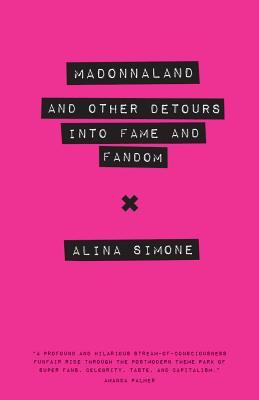
Mapping Madonnaland

Alina Simone is a singer-turned-writer whose work has appeared in the New York Times, New York Times Magazine, Slate, The Wall Street Journal and the Guardian Long Read. She has authored two other books: the "vibrant, taut and humorous" You Must Go and Win (Kirkus Review), and the "wisecracking, mordantly observant, wide-awake" Note to Self (O Magazine). She's the daughter of political refugees from Soviet-controlled Ukraine (her father refused recruitment into the KGB) and happens to be hilarious.

When Simone agreed to write a book about Madonna for UT Press, she thought it might provide an interesting excuse to indulge her own eighties nostalgia. Wrong. While writing Madonnaland: And Other Detours into Fame and Fandomshe discovered not only an endless torrent of information on Madonna and her own ambivalence/jealousy of the Material Girl’s overwhelming commercial success, but also some quirky detours through the backroads of celebrity and fandom in America.

We put together the infographic below to illustrate some of the strange, compelling detours Alina Simone followed on her quest to write Madonnaland. Simone wrestles with Madonna's sexual politics and the "anti-Madonna" Sinead O'Connor. She delves into another Bay City, Michigan, musical act—the all-Latino Question Mark and the Mysterians of "96 Tears" fame. She excavates a black classic rock band whose mystery and rare vinyl cred rivals that of the guys from A Band Called Death. We've also excerpted a portion of the book below and thrown in a Madonnaland-themed Spotify playlist.

Enter to win a copy of Madonnaland on Goodreads!


Goodreads Book Giveaway

Madonnaland by Alina Simone

Madonnaland

by Alina Simone

Giveaway ends April 30, 2016.
See the giveaway details at Goodreads.
Enter Giveaway


Excerpt


The first thing you see as you enter Bay City, Michigan, heading down M-25 West, is a sign commemorating the 2008 state championship win of the All Saints High School’s bowling, baseball, and softball teams. Further down M-25, beyond a historic district lined with the nineteenth-century homes of lumber barons, a sign celebrates the sister cities of Ansbach, Germany (capital of Middle Franconia), and Goderich, Ontario (home to the world’s largest undergound salt mine). Yet a third sign, located a few blocks north, announces Bay City as the hometown of Katie Lynn Laroche, Miss Michigan 2010. None of these signs are unusual for a quiet city of thirty-five thousand tucked between the Mitten State’s thumb and forefinger, but their subject matter does tell you a few things: that Bay City isn’t above a little self-congratulation, that you don’t have to be Helen Keller or Martin Luther King to have your name immortalized in painted metal on either end of M-25, and that Bay City doesn’t necessarily have a surplus of sign-worthy things to say about itself. Insofar as the third point goes, that turns out not to be true. The top-selling female artist in history and one of the most famous women alive, Madonna Louise Veronica Ciccone, was born in Bay City on August 16, 1958. A fact commemorated by the city exactly nowhere.

I’d been commissioned to write a book about Madonna, a project I’d taken on with enthusiasm, even bluster. After all, I still had my original copy of Like a Virgin on vinyl, an archive of back issues of Teen Beat magazine, and a Slinky’s worth of calcified black rubber bracelets in my parents’ closet back home. I’d spent more than half my life surfing the sine waves of Madonna’s career and could casually rattle off details both intimate and frighteningly banal about her sex life, her workout regime, her stance on the gifting of hydrangeas, and the unfortunate rodent problem she’d experienced of late at her $32 million compound on East Eighty-First Street, where a rat had been glimpsed scurrying into the bathroom while she discussed the possibility of collaborating again with Britney Spears during a video chat with the online radio show Saturday Night with Romeo.

Looking back, these qualifications were perhaps less than PhD-strength.