Showing posts with label race in America. Show all posts

Wednesday, June 10, 2020

On Publishing and Racial Justice

June 10, 2020 - This week George Floyd is being celebrated in Houston, where he grew up. In our home state of Texas and throughout the country, protestors have raised their voices against the systematic suppression of Black voices, the excessive use of force against protestors, and the murders of named and unnamed Black people. The University of Texas Press joins these condemnations and supports the essential and urgent work of the Black Lives Matter movement.

Our publishing mission is to serve the people of Texas and knowledge seekers around the world by publishing valuable and relevant information to educate, advance scholarship, and deepen our understanding of history, current events, and contemporary cultures. Our authors reveal the connections between law enforcement along the US-Mexico border and the militarization of the police in this country. They study how cultural trauma is disproportionally inflicted upon and suffered by communities of color, the severity of which is compounded by white systems of power. And they examine the personal histories and the cultural impact of art created, transformed, and advanced by Black creators.

We believe deeply that these kinds of books, and the historical and cultural perspectives they foster, have an important role to play in the broader conversations now taking place. At the same time, we acknowledge that the book publishing industry itself, with a Black workforce of only 5 percent, has a very long way to go. Without the opportunities for meaningful and gainful entry-level jobs, barriers remain for young publishers of color. Unpaid internships; poor oversight of recruitment, promotion, and retainment; and a broad lack of equity training and accountability systems have made publishing an unwelcoming field for Black professionals.

The University of Texas Press is committed to asking difficult questions of ourselves and our institution to purposefully seek solutions. We are committed to the ongoing work of increasing staff diversity while providing professional development opportunities, training all staff to participate in an equitable work environment, and regularly reviewing our acquisitions and peer review practices to ensure broad representation. We are committed to advancing the works and expertise of Black scholars and artists, decentering whiteness when celebrating Black cultural production, and investing deliberately in our outreach to share publishing opportunities and market Black authors.

It is crucial for us to reckon with privilege, gather our peers, and actively protect and advance the rights, lives, and self-determination of Black people. In the coming weeks and months, we will be joining with others in listening, amplifying voices, sharing resources, and centering the work that must be done. In a time of uncertainty, precarity, and division, our ears and our inboxes are open.

As we continue to educate ourselves in efforts to dismantle white supremacy, we also want to do our part to elevate Black voices. We have compiled a list of our staff’s favorite books by Black authors who have made an impact on us, especially at a time when context and deep thinking are necessary.

  • Affrilachia, Frank X Walker
  • The Age of Phillis, Honorée Fanonne Jeffers
  • Americanah, Chimamanda Ngozi Adichie
  • An American Marriage, Tayari Jones
  • American Sonnets for My Past and Future Assasin, Terrance Hayes
  • The Autobiography of Malcolm X, as told to Alex Haley
  • The Ballad of Black Tom, Victor LaValle
  • Becoming, Michelle Obama
  • Between the World and Me, Ta-Nehisi Coates
  • The Birds of Opulence, Crystal Wilkinson
  • Blackberries, Blackberries, Crystal Wilkinson
  • Black Bone: 25 Years of Affrilachian Writers, edited by Bianca Spriggs and Jeremy Paden
  • Black from the Future: A Collection of Black Speculative Fiction, edited by Stephanie Andrea Allen and Lauren Cherelle
  • Black Marxism: The Making of the Black Radical Tradition, Cedric Robinson
  • The Black Poets, Dudley Randall
  • Black Skins, White Masks, Franz Fanon
  • Black, White, and in Color: Essays on American Literature and Culture, Hortense Spillers
  • Bone Black: Memories of Girlhood, bell hooks
  • Book of Hours: Poems, Kevin Young
  • The Book of Night Women, Marlon James
  • A Bound Woman Is a Dangerous Thing: The Incarceration of African American Women from Harriet Tubman to Sandra Bland, DaMaris B. Hill
  • Born a Crime: Stories from a South African Childhood, Trevor Noah
  • The Bridge of Beyond, Simone Schwarz-Bart
  • Brief History of Seven Killings, Marlon James
  • Broken Earth series, N. K. Jemisin
  • Brown: Poems, Kevin Young
  • Bunk: The Rise of Hoaxes, Humbug, Plagiarists, Phonies, Post-Facts, and Fake News, Kevin Young
  • Cane, Jean Toomer
  • Can't Escape Love, Alyssa Cole
  • The Century Cycle (plays), August Wilson
  • The Changeling, Victor LaValle
  • Changing My Mind: Occasional Essays, Zadie Smith
  • Clotel, or the President's Daughter, William Wells Brown
  • The Color Purple, Alice Walker
  • Condemnation of Blackness: Race, Crime, and the Making of Modern Urban America, Khalil Gibran Muhammad
  • Cooking Gene: A Journey Through African American Culinary History in the Old South, Michael Twitty
  • Dawn, Octavia Butler
  • Delicious Foods, James Hannaham
  • Dispossessed Lives: Enslaved Women, Violence, and the Archive, Marisa Fuentes 
  • Don’t Call Us Dead: Poems, Danez Smith
  • The Edna Lewis Cookbook, Edna Lewis and Evangeline Peterson
  • Eight Men: Short Stories, Richard Wright
  • Eloquent Rage: A Black Feminist Discovers Her Superpower, Brittney Cooper
  • For Colored Girls Who Have Considered Suicide/When the Rainbow is Enuf, Ntozake Shange
  • Freedom as Marronage, Neil Roberts
  • Friday Black, Nana Kwame Adjei-Brenyah
  • Gather Together in My Name, Maya Angelou
  • Get a Life, Chloe Brown, Talia Hibbert
  • Giovanni’s Room, James Baldwin
  • Golden Gulag: Prisons, Surplus, Crisis, and Opposition in Globalizing California, Ruth Wilson Gilmore
  • The Good Lord Bird, James McBride
  • The Hate U Give, Angie Thomas
  • Head Off and Split, Nikky Finney
  • The Heart of a Woman, Maya Angelou
  • Heavy: An American Memoir, Kiese Laymon
  • The History of White People, Nell Irvin Painter
  • Home, Toni Morrison
  • Homegoing, Yaa Gyasi
  • How to Slowly Kill Yourself and Others in America, Kiese Laymon
  • I Know Why the Caged Bird Sings, Maya Angelou
  • In Search of the Black Fantastic: Politics and Popular Culture in the Post-Civil Rights Era, Richard Iton
  • Insurrections, Rion Amilcar Scott
  • Intimate Justice: The Black Female Body and the Body Politic, Shatema Threadcraft
  • Invisible Man, Ralph Ellison
  • Isaac Murphy: I Dedicate This Ride, Frank X Walker
  • Just Mercy: A Story of Justice and Redemption, Bryan Stevenson
  • The Known World, Edward P. Jones
  • Life’s Work: A Moral Argument for Choice, Dr. Willie Parker
  • Lose Your Mother: A Journey Along the Atlantic Slave Route, Saidiya Hartman
  • Loving Day, Mat Johnson
  • Men We Reaped: A Memoir, Jesmyn Ward
  • The New Jim Crow: Mass Incarceration in the Age of Colorblindness, Michelle Alexander
  • No Mercy Here: Gender, Punishment, and the Making of Jim Crow Modernity, Sarah Haley
  • On Beauty, Zadie Smith
  • On the Come Up, Angie Thomas
  • The Poet X, Elizabeth Acevedo
  • Praise Song for the Day: A Poem for Barack Obama's Presidential Inauguration, January 20, 2009, Elizabeth Alexander
  • Prelude to Bruise, Saeed Jones
  • The Price for Their Pound of Flesh: The Value of the Enslaved, from Womb to Grave, in the Building of a Nation, Daina Ramey Berry
  • Pride, Ibi Zoboi
  • Racecraft: The Soul of Inequality in American Life, Karen E. Fields and Barbara J. Fields
  • Race Rebels: Culture, Politics, and the Black Working Class, Robin D. G. Kelley
  • Rafe: A Buff Male Nanny, Rebekah Weatherspoon
  • Recyclopedia, Harryette Mullen
  • The Sellout, Paul Beatty
  • Singin' and Swingin' and Gettin' Merry Like Christmas, Maya Angelou
  • Sing, Unburied, Sing, Jesmyn Ward
  • A Small Place, Jamaica Kincaid
  • Song of Solomon, Toni Morrison
  • The Stars and the Blackness Between Them, Junauda Petrus
  • Sula, Toni Morrison
  • Summer Lightning, Olive Senior
  • Swallow the Fish, Gabrielle Civil
  • Tar Baby, Toni Morrison
  • Texaco, Patrick Chamoiseau
  • Their Eyes Were Watching God, Zora Neale Hurston
  • They Can’t Kill Us Until They Kill Us, Hanif Abdurraqib
  • Thick: And Other Essays, Tressie McMillan Cottom
  • The Thing Around Your Neck, Chimamanda Ngozi Adiche
  • The Underground Railroad, Colson Whitehead
  • The Venus Hottentot: Poems, Elizabeth Alexander
  • The Warmth of Other Suns, Isabel Wilkerson
  • We Are Never Meeting in Real Life: Essays, Samantha Irby
  • We Were Eight Years in Power: An American Tragedy, Ta-Nehisi Coates
  • The works of Stuart Hall
  • The Wretched of the Earth, Franz Fanon
  • You Can’t Keep a Good Woman Down, Alice Walker
  • Zone One, Colson Whitehead

Thursday, April 25, 2019

Announcing a New Series—Latinx: The Future is Now

Latinx: The Future Is Now is a new interdisciplinary series devoted to the evolving field of Latina/o/x studies, including Central American, Afro-Latinx, and Asian-Latinx studies. Situated at the nexus of cultural, performance, historical, food, environmental, and textual studies, the series will focus on ways in which the racial, cultural, and social formations of historical Latinx communities can engage and enhance scholarship across geographies and nationalities. The series editors invite projects that consider the multiple queer and gender-fluid possibilities that are embodied in the “x”; projects that have a feminist critique of patriarchy at the center of their intellectual work; projects that deploy a relational approach to ethnic and national groups; and projects that address the overlapping dynamics of gender, race, sexual, and national identities.

Submissions or queries may be directed to the series editors, Nicole Guidotti-Hernandez, nicole.m.guidotti-hernandez@emory.edu and Lorgia Garcia-Peña, garciapena@fas.harvard.edu in addition to Senior Acquisitions Editor, Kerry Webb, kwebb@utpress.utexas.edu.

Forthcoming books in the series will be listed here as they are published: https://utpress.utexas.edu/books/series/latinx-future-now.

# # #


Dr. Nicole M. Guidotti-Hernández is Professor in the Department of English at Emory University. She is an expert in Borderlands History after 1846, Transnational Feminist Methodologies, Latinx Studies, and Popular Culture and Immigration. As a public intellectual, Dr. Guidotti-Hernández has written numerous articles for the feminist magazine Ms. and the feminist blog The Feminist Wire, covering such topics as immigration, reproductive rights, and the Dream act. She also sits on the national advisory council for the Ms. and is currently on the national advisory council for Freedom University in Athens, Georgia.

Dr. Lorgia Garcia-Peña i
s the Roy G. Clouse Associate Professor of Latinx Studies at Harvard University. She is the author of  award-winning book The Borders of Dominicanidad and the co-founder of Freedom University Georgia, a modern-day freedom school created to support undocumented students.  

www.utexaspress.com

Thursday, January 11, 2018

Lauren Rebecca Sklaroff on the History of Black Celebrity in American Politics

Lauren Rebecca Sklaroff's forthcoming book Red Hot Mama: The Life of Sophie Tucker explores how the “First Lady of Show Business” became one of the most powerful women in Hollywood. But what does being a powerful woman in Hollywood actually mean in the political sphere? Sklaroff's exciting biography highlights Sophie Tucker's dedication to social justice—she advocated for African Americans in the entertainment industry, cultivated friendships with leading black activists and performers, and raised over four million dollars for the religious and racial causes she held dear. As a leading scholar of American cultural history, Lauren Rebecca Sklaroff provides historical context to the current debate over Oprah's celebrity and her hypothetical presidential candidacy. Red Hot Mama publishes in April. Enjoy this piece originally published in The Conversation.

For black celebrities like Oprah, it's impossible to be apolitical


File 20180110 46697 1d0ovb7.jpg?ixlib=rb 1.1
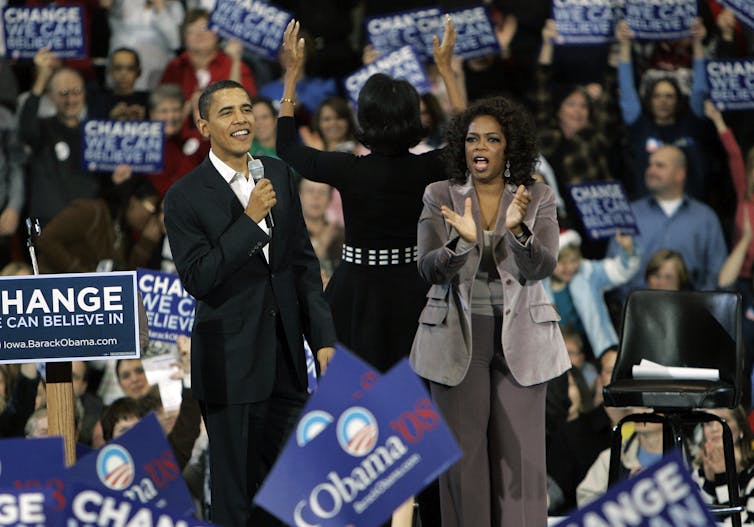
Barack Obama and Oprah Winfrey appear during a rally in Cedar Rapids, Iowa on Dec. 8, 2007. AP Photo/Paul Sancya
Lauren Rebecca Sklaroff, University of South Carolina

Oprah Winfrey’s rousing Golden Globe speech has many speculating whether the media mogul will become a presidential candidate in 2020, with some pundits questioning the merits of another “celebrity” president.

But to equate Oprah with other “celebrity” politicians like Donald Trump and Arnold Schwarzenegger skirts the history of how black celebrities have long assumed political roles – often unintentionally – within the black community.

When it’s viewed through this lens, the transition into politics for someone like Winfrey is more natural. Oprah, for her part, seems to understand the tremendous importance of high-profile blacks in American society. During her monologue, she became emotional when she described how, as a young girl, she watched Sidney Poitier receive the Cecil B. DeMille Award at the 1964 Golden Globes – “I’d never seen a black man being celebrated like that.”

But the ability of black celebrities to symbolize hope and racial progress precedes Poitier. The black singers, actors and athletes of the 1930s and 1940s weren’t simply entertainers; they were living proof that African-Americans didn’t need to succumb to racist stereotypes, and could be treated with dignity, even deference. With structural racism embedded in the nation’s social and economic fabric, this, in and of itself, was a political act.

As I point out in my book “Black Culture and the New Deal,” during the Great Depression and World War II, the U.S. government recognized the political potency of the black celebrity, and would tap into this power to project a democratic ethos at home and abroad.


Elevating the black cultural hero


By the time Franklin D. Roosevelt decided to seek a second presidential term in 1936, African-American voters had become an important demographic for the Democratic Party. But with white Southerners comprising a significant part of Roosevelt’s base, segregation and discrimination were more difficult for the government to directly confront.

Roosevelt still needed to figure out a way to reach out to the black community. So instead of passing legislation to correct racial inequality, his administration developed cultural programs that would employ large numbers of black men and women, and promote the skills and abilities of African-Americans.

For example, New Deal Arts programs included individuals such as Carlton Moss, Sterling Brown and Zora Neale Hurston to create books and plays that would depict African-Americans in sympathetic, humane ways. The Federal Writers’ Project’s American Guide Series, which Brown edited, highlighted the diversity of African-American communities and customs. The Federal Theater Project featured plays written and directed by black men and women that grappled with pressing racial issues.

This was a potent political tool; federal officials understood that African-Americans would be deeply affected – as Winfrey later was when watching Poitier receive the DeMille Award – by seeing African-Americans portrayed in more realistic and respectful ways.


A message of unity and freedom


The stakes became even greater as America entered World War II. Simmering racial tensions needed to be reconciled with America’s democratic, anti-fascist ideals.

Cultural programs promoting racial cooperation abounded within war agencies. Office of War Information posters and Hollywood films such as “Bataan” featured white and black men working and fighting together.

But no one was more central to this brand of propaganda than boxer Joe Louis.

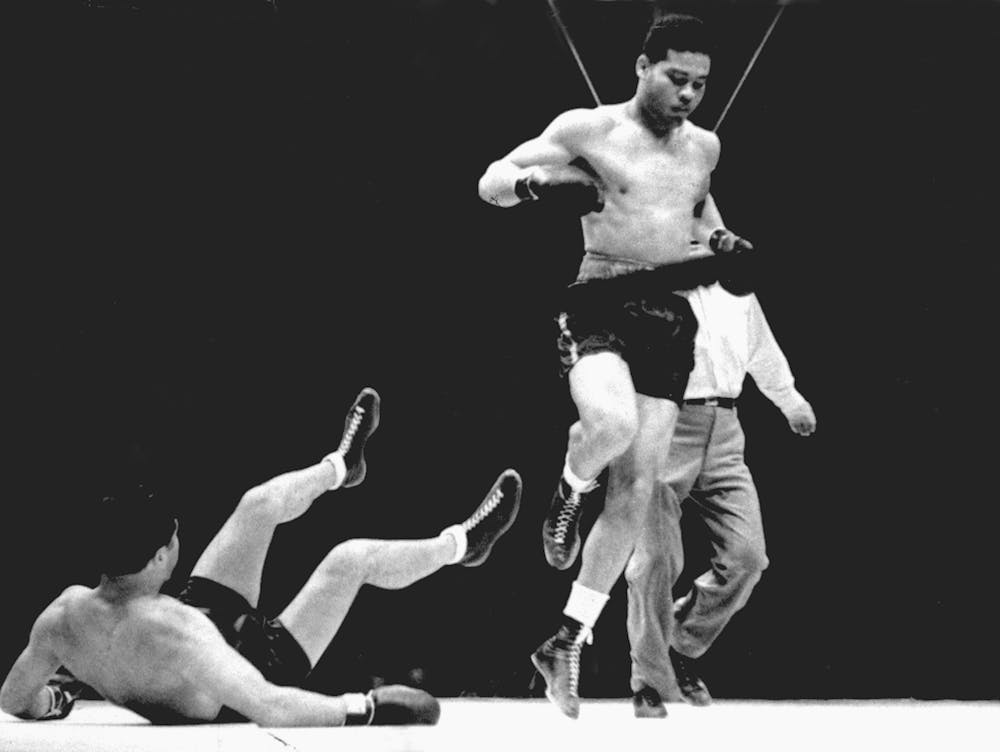
In 1938, Louis had stunned the world by defeating German Max Schmeling. Geopolitically, it was a display of American superiority. But for African-Americans it was a triumph over whites.


Heavyweight champion Joe Louis dances as German challenger Max Schmeling falls to the canvas in the first and final round of their rematch in New York City in June 1938. AP Photo
Unassuming and apolitical, Louis didn’t ever talk about racial issues. Nonetheless, he became a hugely important political figure.

Poet Maya Angelou wrote of Louis’ victories as evidence that African-Americans were the “strongest people in the world”; novelist Richard Wright described Louis’ victories as “a fleeting glimpse … of the heart that beats and suffers and hopes for freedom.”

Recognizing Louis’ profound appeal, the government quickly swooped in, employing him in the Army’s Morale Division to boost patriotism among African-Americans during World War II.

As one government official noted in 1942, “It might be well to ask the questions as to who would draw the biggest audiences, Joe Louis or [NAACP Executive Secretary] Walter White. The answer is obvious.”

During his 46 months in the Army, Louis partook in 96 exhibition fights in the U.S. and abroad as part of a troupe that included black boxers George C. Nicholson, Sugar Ray Robinson and George J. Wilson. He also appeared on posters and in films that promoted racial inclusion, such as “The Negro Soldier.”

Louis wasn’t the only black cultural hero to play a political role during the war. The Armed Forces Radio Service created a program featuring black musicians called “Jubilee.” Lena Horne, Cab Calloway, Duke Ellington and others appeared in this weekly program that was broadcast domestically and to servicemen abroad. It reassured black troops on the front lines, while many white soldiers were able to listen to musicians they had never heard before.


The power of the stage


These federal efforts during the Great Depression and World War II are complicated. One the one hand, it could be argued that they represented a tokenistic appeal to African-Americans in lieu of real social and economic change. On the other, there’s no doubt that African-Americans were given the opportunity to be themselves, be celebrated, and move beyond the demeaning stereotypes that had existed for decades.

In the postwar period, civil rights leaders challenged African-American celebrities to use their platform to promote racial equality. Some, like Muhammad Ali, famously called for change, while others were more reticent. But the political stance of these individuals may not have mattered as much as their visibility and success. As filmmaker Ezra Edelman argues in his 2016 documentary “O.J.: Made in America,” even as Simpson insisted that we was “not black, just O.J.,” he was still embraced by the black community, and lauded as an African-American hero.

After centuries of degradation and discrimination, the accomplishments of African-Americans like Simpson or Oscar winner Hattie McDaniel possessed a political resonance. Though they were reluctant to promote racial change, by succeeding in traditionally exclusionary industries, they nonetheless became political figures. They signaled to other African-Americans that barriers could be broken down. Even if they weren’t activists themselves, they inspired others to fight inequality.

As a black woman, Oprah Winfrey occupies a unique space in this legacy of cultural heroes. Though it remains to be seen whether her candidacy will become a reality, she knows the significance of her actions for people of color in the U.S. and around the world. At a time when black women remain marginalized, Oprah – media mogul, actress, philanthropist, tastemaker – embodies the American Dream. People still look to cultural figures as much as they look to politicians for inspiration.

As Oprah stated in her speech, her life and career demonstrate how “we can overcome.”

Lauren Rebecca Sklaroff, Associate Professor of History, University of South Carolina

This article was originally published on The Conversation. Read the original article.

Wednesday, April 26, 2017

Making America Confederate Again

Mississippi and Alabama officially observe Confederate Memorial Day. Recently, a candidate for Virginia governor was endorsed by a prominent neo-Confederate at the 'Old South Ball'. Accounting for the rise in hate crimes and racially-motivated incidents since Trump's election, we're looking back at a piece of scholarship with alarming relevance today. 

In 2008, Euan Hague, Edward H. Sebesta, and Heidi Beirich, published a groundbreaking book, Neo-Confederacy: A Critical Introduction, that described a fringe movement of political activists who promoted an ideology of Confederate nationalism. Advocating for the secession of fifteen states to form a new Confederation of Southern States, neo-Confederates advanced a politics that was at its core anti-democratic (and anti-Democratic). Of course, almost ten years later secession has not happened, but as many scholars have long suggested about political movements, what purports to be new can
More info
often be found by taking a deeper look at the recent past. Indeed, as President Abraham Lincoln is reported to have said, “Every effect must have its cause. The past is the cause of the present, and the present will be the cause of the future.” It is this understanding that makes Neo-Confederacy a prescient guide to what was to come. As Hague, Sebesta, and Beirich noted, neo-Confederate activists at the end of the twentieth century wanted nothing less than “to change the [U.S.] social order,” arguing for a need to transform “American cultural, educational, political and religious practices.”

As Neo-Confederacy: A Critical Introduction describes, this meant valorizing whiteness and “Anglo-Celtic” culture, praising violence and masculinity, while simultaneously rejecting “political correctness” and international governmental collaborations, vilifying ethnic and sexual minorities, vociferously opposing non-European immigrants, and questioning American democratic processes of both the electoral system and the franchise. Neo-Confederacy wrapped these positions up in an appeal to Constitutional orginialism, “orthodox” Christianity, and a demand for national self-determination for the US South. Revisiting the book almost a decade after its original publication, one cannot but think that the collection’s assessment of this political fringe describes a phenomenon that, albeit perhaps now ostensibly detached from its forthright advocacy of a new Confederate nation-state, has moved powerfully into the mainstream of American politics. As esteemed historian James Loewen noted in the foreword, in examining neo-Confederacy, “Hague, Sebesta, and Beirich have done the heavy lifting... they have created an essential tool for those who work to bring justice and healing across racial and sectional divides in America.” Given the current state of US politics, Neo-Confederacy is an urgent primer for our new reality.

Dr. Euan Hague is a Professor of Geography at DePaul University, and Edward H. Sebesta is an independent researcher. We asked them to comment on how this 2008 collection, Neo-Confederacy: A Critical Introduction, resonates with the rhetoric and policies advanced by the new Trump administration.

Dr. Michael Hill speaking at a Confederate Memorial Day Parade, Northport, Alabama, 26 April 1997. (Photograph by Gerald R. Webster)

A Nationalist Call to Arms

Euan Hague and Edward H. Sebesta


Like many American magazines in January 2017, Chronicles: A Magazine of American Culture had on its cover a photograph of Donald Trump: “Time to Begin” read the caption. This was not the first time that we had encountered Chronicles or its publisher, the Illinois-based Rockford Institute. In the 1990s, Chronicles had led an ideological charge that rejected much of US domestic policy as unconstitutional, lamented US foreign policy and transnational organizations, decried ‘activist judges,’ and railed against multiculturalism. Its editor, and lead contributor at the time, was Thomas Fleming. Fleming had also been a cofounder of Southern Partisan magazine in 1979, an imprint of the Foundation for American Education, which regularly published interviews with leading figures of the Republican right such as Trent Lott. At the Rockford Institute, Fleming invited colleagues from his Southern Partisan days to write for Chronicles and, in June 1994 alongside twenty-six others, he helped establish a new political party: the Southern League (which was renamed as the League of the South in 1997). Influenced by growing right-wing ethnic nationalism and nationalist leaders in Europe, such as those contributing to the collapse of Yugoslavia and Umberto Bossi in Italy, a year later Fleming and Southern League President James Michael Hill issued their nationalist call to arms in The Washington Post. On 29 October 1995, “The New Dixie Manifesto” set forth a Confederate nationalist agenda that argued for devolution of federal power to the states, local control over schools and education policy, and for the right of peoples to pursue and preserve their “authentic cultural traditions.” The Manifesto questioned the very concept of “America” as a united country of states and lamented that “national uniformity is being imposed by the political class that runs Washington, the economic class that owns Wall Street and the cultural class in charge of Hollywood and the Ivy League.” What was needed to challenge this US “multicultural, continental empire, ruled from Washington by federal agencies and under the thumb of the federal judiciary,” was an emboldened populace that would reject both the Democratic Party and craven establishment Republicans, and instead elect bold representatives that would reject federal regulations and interventions in state and local affairs. Those leading this charge would “insist upon a strict construction of the Constitution” and be “real people” from “the provinces, the sticks, the boondocks,” in particular the former states of the Confederacy. The manifesto envisioned a nationalist party, the Southern League, to advance these aims. This nascent right wing ideology gained supporters as Southern League members contributed essays and political analyses to websites, newsletters, and conservative talk radio stations. Advocates outlined their ideas in numerous books, often published in their tens of thousands by small, specialized presses that could maximize sales online to a dedicated audience of enthusiastic supporters. Some contributors were faculty members at prominent institutions in Georgia and Alabama; others, as Neo-Confederacy:A Critical Introduction documented, were white nationalists, such as Jared Taylor of American Renaissance and members of the Council of Conservative Citizens. Neo-Confederacy aligned with ideological positions, such as those proposed by Samuel Huntington, that understood the United States (and the Western world more generally) to be engaged in a ‘clash of civilizations’ with Islam and the Islamic world. Within such a conceptualization of global geopolitics, neo-Confederate organizations like the League of the South demanded that a person’s ethno-religious identity is their primary basis for belief, and echoed this perspective in the United States by valorizing a “white, Anglo-Celtic” ethnic group and its “orthodox Christianity.”


Monday, February 20, 2017

Interview with Stanley Corkin on The Wire

Stanley Corkin's new book is the first comprehensive, season-by-season analysis of the critically acclaimed HBO series The Wire. His book explicates the complex narrative arc of the entire series and its sweeping vision of institutional failure in the postindustrial United States. We're running an interview the University of Cincinnati conducted with Professor Corkin to celebrate the publication of Connecting The Wire: Race, Space, and Post-Industrial Baltimore.

Connecting The Wire Interview

By Jac Kern

Originally posted February 13, 2017 by University of Cincinnati for UC Magazine

The Wire aired on HBO from 2002-08, but still maintains a growing audience today. Photo/HBO

More info
As University of Cincinnati English and History professor Stanley Corkin enters his 30th year at UC, he adds a new book to his repertoire of works on mass culture (film, television and other popular media) and history.

In this latest release, Connecting The Wire: Race, Space, and Postindustrial Baltimore, Corkin offers a season-by-season analysis of HBO’s 2002-08 crime drama The Wire.

Following law enforcement in Baltimore, each season explored the police in relation to a different institutional entity: initially, the illegal drug trade, then unionized work on the Baltimore waterfront, city government, the public school system and finally in its last season, the news media.

The show was hailed by critics and adored by fans, but never brought in top ratings or managed to score an Emmy Award. Today, it is universally considered one of the best American television dramas and continues to gain a growing fan base following its run on TV through streaming services like HBO Go and Amazon Prime. Corkin’s book is the first comprehensive scholarly study of The Wire.

A key figure in the emerging film program in UC’s College of Arts and Sciences, Corkin’s books include Realism and the Birth of the Modern United States: Cinema, Literature, and Culture (1996), Cowboys as Cold Warriors: The Western and U.S. History (2004) and Starring New York: Filming the Grime and Glamour of the Long 1970s (2011).

Give us an overview of the book and why you wanted to write about The Wire.

I had always endlessly been interested in urban geography. As I was finishing my last book—I’m always trying to think of the next project—one of my kids had brought The Wire to my attention. I binge-watched it, and I loved it. I thought it was a great show—sociologically and historically interesting. I’ve written about race and urban life a lot over the course of my career so I thought this would be a natural next thing to do.

The showrunner, David Simon, tried initially to respond to genre expectations in the first season. It’s really within “noir-ish” crime drama caper stuff, but after that, in subsequent seasons, he gives you four different ways of looking at a given American city—in this case, Baltimore—within the context of a neoliberal cultural moment. I thought that was really powerful.


Author and UC professor Stanley Corkin. Photo/provided
The Wire is very specific to Baltimore, as opposed to other shows set in New York or Los Angeles or a fictional city. What is the significance of this setting?

Baltimore is below the level of the mega successful, international cities. So the fact that it’s not New York or Chicago or LA; nor is it even San Francisco, Boston, or Houston—makes it like many cities in a lot of ways. Baltimore is a perfect neoliberal specimen. It’s a city that didn’t quite boom when the economic system changed in the '90s. Cities that didn’t boom, like Cincinnati, kind of got left behind and they’re just picking up the residue of that restructuring of international economics. And just like Cincinnati now is relatively booming, so is Baltimore.


Monday, October 31, 2016

An Afrofuturist Guide to the Cosmos

By Paul Youngquist


He came from Saturn. He traveled the space ways. He created better music for a better world. Sun Ra’s reputation as an inspired musician is finally on the rise. But Sun Ra was much more than that: a poet, a prophet, and an activist whose medium was sound. “I
More info
would hate to pass through a planet,” he once said, “and not leave it a better place.” He did just that, if the stunning body of recording he left behind is any measure: hundreds of LPs, miles of tape, and countless fan recordings of concerts, radio broadcasts, and interviews.

He created a cosmos of sound. A Pure Solar World: Sun Ra and the Birth of Afrofuturism explores its origins and aims: the places that inspire Sun Ra’s music and the spaces it opens for new ways of living, especially for African Americans. As a black man from Birmingham, Alabama, who moved to mid-century Chicago (to speak in earthly terms), Sun Ra experienced first-hand the indignities of racism and segregation. He created a better future by composing music and writing poetry. His glorious achievement makes him the granddaddy of Afrofuturism, the contemporary cultural movement dedicated to imagining new black worlds.

The only way into the future for Sun Ra is through space age sound. This playlist follows the long arc of his career with the “Arkestra,” the name he gave his shape-shifting band. From inner city to outer space: Sun Ra’s exploratory music moves from the familiar to the otherworldly and back again. It was always a collaborative voyage involving diverse musicians, audiences, and supporters, financial and spiritual. You’re part of it now. Listen with an open heart. Imagine a better tomorrow.


“Super Blonde”: The Sun Ra Arkestra’s very first release, a 45 rpm single appearing in 1956. “Super Blonde” reappears a year later on El Saturn’s first LP, Super-Sonic Jazz. The tune announces the arrival on planet Earth of a formidable ensemble, skilled in the herky-jerky rhythms of bebop. The harmonized head, coming after Sun Ra’s mid-tempo piano intro, is pure Charlie Parker. Boppers beware!

“Spaceship Lullaby”: Rehearsal tapes contain wonders, and Sun Ra always had tapes running. In the mid-fifties he coached several doo-wop ensembles. The singers here called their group The Nu Sounds, and Sun Ra arranged their harmonies. In this case he wrote their lyrics too, including phrases appearing again in later Arkestra recordings: “zoom, zoom, up in the air,” and “interplanetary melodies.” The Nu Sounds’s space trip takes a dangerous turn when the singers must fly through the sun to arrive at Saturn.


Thursday, May 12, 2016

Black Women, Music, and Community

Danny Alexander is a white man who has written a book about a black female artist: Real Love, No Drama: The Music of Mary J. Blige. Mary J. Blige grew up in Yonkers, New York, and Danny Alexander grew up in small town Oklahoma. Their backgrounds and life experiences couldn't be more different, but Blige's music has a way of connecting people. As America continues to wrestle with racial difference, Danny Alexander's new book is a testament to the hope that deeply personal and politically conscious music—like that of Mary J. Blige and many others—can bring about a more "woke" world. We asked Danny to write about what brought him to this project.

Goodreads Book Giveaway

Real Love, No Drama by Danny Alexander

Real Love, No Drama

by Danny Alexander

Giveaway ends June 30, 2016.
See the giveaway details at Goodreads.
Enter Giveaway
More info

Why I Wrote a Book on The Queen of Hip Hop Soul
By Danny Alexander

My hometown library was built and long curated by a somewhat famous librarian named Ruth Brown, who just happens to share her name with the R&B artist who famously built Atlantic Records. In 1950, Bartlesville, Oklahoma’s Ruth Brown was fired for her civil rights activities, principally her work integrating the library around the children’s story hour. She was a member of the Congress for Racial Equality and was labeled a communist. Bette Davis played a fictionalized version of her in the 1956 movie Storm Center, yet she remains known mainly in civil rights circles (the Cold War environment I lived in as a child meant I didn’t even learn Brown’s story until years after I moved away). Since my own writing career has been focused on freedom of expression and a belief in trying to cross social boundaries that, in general, remain intact sixty-six years later, I was proud to have my first book signing across from her portrait in her former library. I was also happy to think she might have approved of the scene before her.


Thursday, December 4, 2014

My Life in the Bronx by Martin Dones


The Bronx of the 1970s and '80s is not the Bronx of today, but the issues affecting urban youth—poverty, drug abuse, violence, and police aggression—haven't magically gone away. Recent racial tensions between police and minority communities in the aftermath of Eric Garner and Michael Brown have brought widespread media attention to the problematic ways some law enforcement behave in urban neighborhoods across the country.

More info
Photographer Stephen Shames' new book Bronx Boys includes an arresting essay by Martin Dones, a Puerto Rican kid who insured Shames gained the trust he needed to photograph life in the Bronx. Dones painfully articulates the truth of trying to survive and have a life in a rough area rife with gang violence. His story is a powerful account of the brutal cycle the young and marginalized find themselves trapped in: no money, little access to quality education, and no trust in the police. We have excerpted part of his essay below. There is much more to his story, and an additional essay by José "Poncho" Muñoz in the book.

We're so proud that Bronx Boys was named one of the 27 photobooks that defined 2014 by Time Magazine: TIME Picks the Best Photobooks of 2014 →

My Memories
By Martin Dones

I don’t know if you remember this cop from the Bronx named Officer Jet. President Clinton gave him an award. Well, it was in the news and everything. A journalist ran around with him. The New York Times Magazine wrote an article about our block and they gave them all nicknames, like Beefcake, Beefhead. He told how bad they were. He said that they made $100,000 a week. They made enough money, but not that much. He told the story the way he thinks the story went. It’s just what he assumes.

This is the real story on how everything happened. How they cut the crack. How the drugs came out of LO’s mother’s house. About their machine guns—their AK47s and M16s. How they had their hands on some real high-power ammunition. How they had enough for a war if anybody came down for it.

This is my story. I’ve been on the street, got tangled in drugs, been in the gangs. I lived through violence—murder, stabbings, fights. The streets helped me learn all the mistakes that I had to learn. I’m sorry that I had to learn them that way, but I had to.

I was a dead man who got lucky.

It’s hard to get out of the ghetto. The ghetto could be fine. You could be raised there and go to college. It’s just the violence—the way things evolved from fistfights to gunfights. Eventually it soaks into you. You learn what you live.

My childhood contributed—the drugs that my mother did. To this day she does drugs. I don’t have a mother. I just have a “mother” who gave birth to me. I have a father, but I’ve only known him since I was twenty-three. As a kid I was mad at my mom. I was mad at the things around me. I’d go out in the street, knowing that I can’t hit my mother, and want to punch somebody in the face—just to get the anger off of me. It’s like you’re locked in a room and you have to do something.

Then again, I had people who were showing me go to school. Telling me, “Do what you have to do. Forget about the streets.”

I’ve known Steve since I was ten years old, and I’m forty-five now. He played a major part in keeping me alive. So did my godparents, Rocky and Connie of the Boys Club, teaching me woodworking and magic, taking me into their home, sometimes giving me the only meal I had that day.

So I had two directions. I had to choose which way I wanted to go. Whether I wanted to go to jail and die or live my life and be happy with my family.

I chose to go with my family and just be a normal person.

Connie once told me, “That’s what life is all about. We’re doing nothing else in life but collecting memories, because after all is said and done, when we’re gone, what do you remember?”

These are my memories.

My First Memory


My first memory is still as clear as a picture: my cousin being murdered. I didn’t actually see him being murdered, but I heard the thud of his body hitting the pavement. That death sound is the first thing I remember. Thud. I jump awake, startled, and everybody is screaming. My mother lies disheveled next to me on the bed, fainted. Everybody is on top of her: “Give her air.” I hop out of bed and run toward the window. That’s where all the action is.

My four-year-old eyes see the playground of the school I will soon attend, every day walking past my memories. A white blanket lies on the black asphalt. A cop lifts the blanket off a body and my cousin’s face, black and blue and all swelled up. He is naked. My mother screams, “Get away from the window.” That is all, but it is enough to fill my head. I still dream about it.

It comes like a flash, without warning while I’m watching TV or walking. Flash. I see his bruised, swollen face, his naked body as the cop pulls off the blanket. It will be with me till the day I die. It is my first memory, one of my highlights growing up.